Coming from Ansible
If you write Ansible, you already think the way Conn3x does. Hosts, tasks that run in order, handlers that fire when something changed. None of that goes away. What changes is where it lives and what you get back before anything runs.
This is the first of three short posts, one for each of the readers from Why Conn3x is one tool. This one is for you if your playbooks came first.
What carries over
A play becomes a circuit. Its hosts become a map of names to addresses, its tasks become steps, and its handlers stay handlers:
| Ansible | Conn3x |
|---|---|
play, hosts: and inventory |
circuit, hosts = { ... } |
| task | step, in the same order |
notify: and handlers |
notify = [handler.NAME] and handler |
become: true |
become = true in the ssh block |
loop: [a, b] with {{ item }} |
for_each = ["a", "b"] with item.value |
--check --diff |
conn3x plan, every time |
| Jinja templates | templatefile syntax in a template step |
The last row is the one that takes real work, and we’ll come back to it.
Let the converter start
You don’t have to rewrite anything by hand to see what your playbook looks like as a circuit. Point the converter at it, with your inventory:
conn3x convert ansible -i inventory.ini -out site.tf site.yml
Here’s a small playbook for two app servers: a few packages in a loop, a service, a user, a sysctl, a config file with a handler, and an environment file rendered from a Jinja template. The converter’s answer:
Converted 5 tasks. 1 thing needs you; each is marked TODO(convert):
  line 34, Write the environment file: renders a Jinja template; rewrite it in templatefile syntax (${var}, %{ if }) and use a template step
conn3x validate on what it wrote.The loop came through as a step that repeats:
step "install_the_basics" {
  for_each = ["chrony", "git", "jq"]
  package {
    name = item.value
  }
}
The config file kept its handler, and the inventory became the circuit’s hosts, with ansible_user as the login:
circuit "app_servers" {
  hosts = {
    app1 = "203.0.113.21"
    app2 = "203.0.113.22"
  }

  ssh {
    user             = "deploy"
    private_key_file = var.ssh_private_key_file
    become           = true
  }
  # ...
}
What it leaves for you
The converter only translates what it can show means the same thing. Everything else stays in the output as the original YAML, commented, under a TODO(convert) line that says why. It never guesses and never drops an argument. If it doesn’t understand one, it leaves the whole task, because a step that quietly does less than your task did is worse than a TODO.
Expect to finish these by hand:
- Jinja templates. Rewrite
{{ var }}as${var}and{% if %}as%{ if }, and use atemplatestep. It renders on your machine, so the plan shows the finished file’s diff. whenandregister. In a circuit, a decision happens at plan time, usually by choosing which hosts a circuit covers.- Loops over variables or over items with fields. Write
for_eachwith a map yourself. - Commands that ran on every play. A step runs when something is out of date, so a
commandneeds acreates,removesorunlessguard to know when it’s done.
The command exits 3 while anything is left, so you can run it in CI until the count reaches zero.
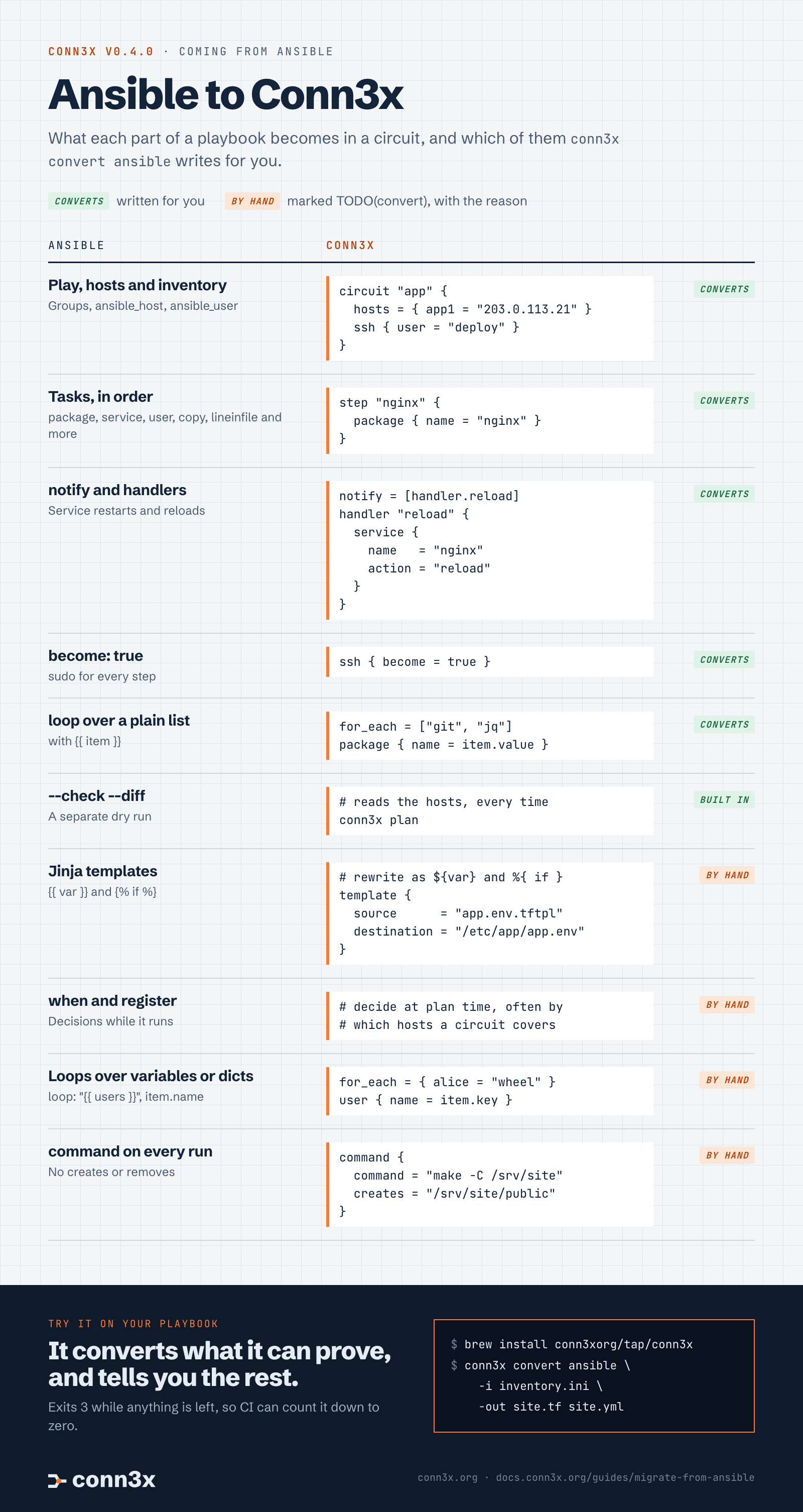
Read the cheat sheet as text
- Converts: a play, its hosts and inventory become a
circuitwithhostsand ansshblock. - Converts: tasks become steps, in the same order.
- Converts:
notifyand handlers becomenotify = [handler.NAME]andhandlerblocks. - Converts:
become: truebecomesbecome = truein thesshblock. - Converts: a
loopover a plain list with{{ item }}becomesfor_eachwithitem.value. - Built in:
--check --diffbecomesconn3x plan, which reads the hosts every time. - By hand: Jinja templates become
templatefilesyntax,${var}and%{ if }, in atemplatestep. - By hand:
whenandregisterbecome decisions at plan time, often which hosts a circuit covers. - By hand: loops over variables or dicts become
for_eachwith a map. - By hand: a
commandthat ran on every play needs acreates,removesorunlessguard. conn3x convert ansibleexits 3 while anything is left, so CI can count it down to zero.
What you get that you didn’t have
A plan you can read before anything runs. Every conn3x plan reads the servers first, so it shows a real diff: the package that’s missing, the line in the file that’s different. In Ansible, that’s a separate --check --diff run you have to remember.
A second run that proves the first. Apply, then plan again. It should say No changes. If it doesn’t, something isn’t idempotent, and you find out now rather than on the next deploy.
Drift you hear about. conn3x drift reads every host and exits 2 when something was changed by hand, so a scheduled job can tell you.
Nothing to install on the servers. No Python on the hosts, no agent. Conn3x logs in over SSH, checks the host key and runs ordinary shell commands.
Try it on your own playbook
brew install conn3xorg/tap/conn3x
conn3x convert ansible -i inventory.ini -out site.tf site.yml
The migration guide lists every module the converter knows. If yours uses one it doesn’t, open an issue with the task, or pick up one that’s waiting. Converter mappings make good first contributions.