Four distributions, every change
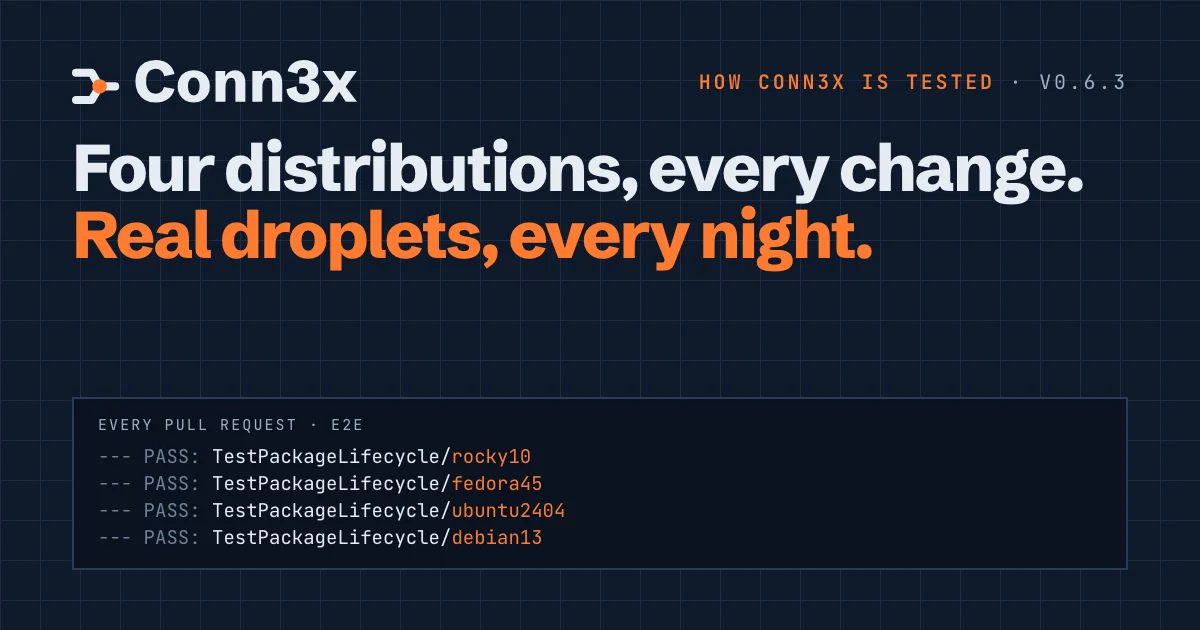
Every pull request to Conn3x is applied to Rocky Linux, Fedora, Ubuntu and Debian hosts before it can merge. Every night, a plan builds real droplets and sets them up. Every release is signed. Here's what each check catches.
A tool that changes your servers is only as good as the last distribution it was tried on. Most of us have met the one that was clearly written on Ubuntu: it calls apt on a Rocky box, restarts ssh where the unit is sshd, and opens a port with ufw on a host that runs firewalld.
You shouldn’t have to find that out on your servers. So before any change to Conn3x reaches you, it passes three gates, and each one catches what the gate before it can’t.
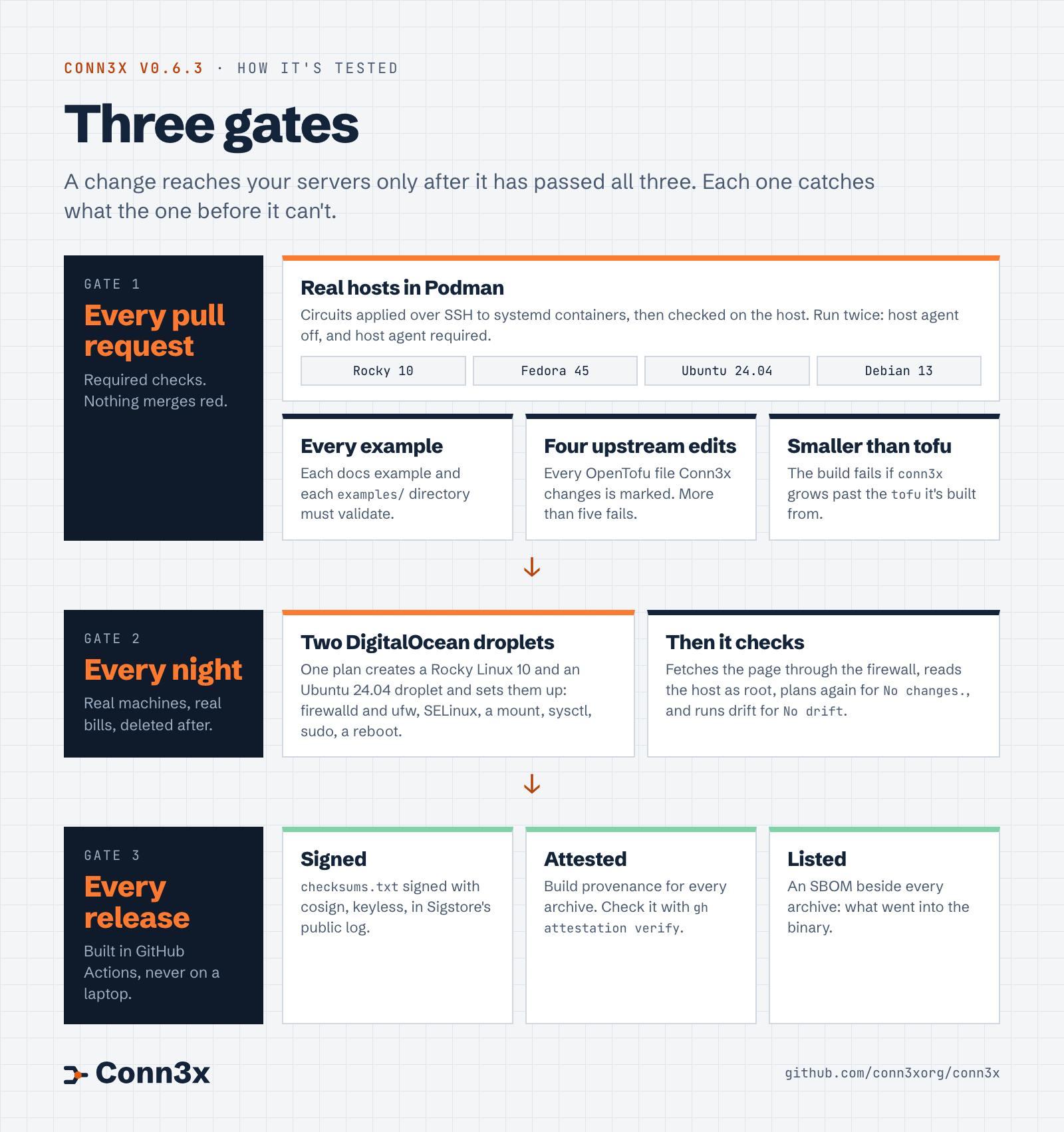
Read the diagram as text
- Every pull request, as required checks: circuits applied over SSH to Rocky Linux 10, Fedora 45, Ubuntu 24.04 and Debian 13 hosts running in Podman, then checked on the host, once with the host agent off and once with it required. Every docs example and every
examples/directory must validate. Every OpenTofu file Conn3x changes is marked, and more than five fails. The build fails ifconn3xgrows more than 3 MB past thetofuit’s built from. - Every night: one plan creates a Rocky Linux 10 and an Ubuntu 24.04 droplet on DigitalOcean and sets them up, with firewalld and ufw, SELinux, a mount, sysctl, sudo and a reboot. Then it fetches the page through the firewall, reads the host as root, plans again for
No changes.and runs drift forNo drift. - Every release: built in GitHub Actions.
checksums.txtis signed with cosign, every archive has build provenance you can check withgh attestation verify, and every archive has an SBOM.
Every pull request: four distributions
The end-to-end tests don’t mock a server. Each one starts a container with systemd running as PID 1 and sshd listening, then drives the real conn3x binary against it over SSH, exactly as you would. The images are built from Containerfiles in the repository:
- Rocky Linux 10, for the RHEL family.
- Fedora 45, which gets new packages and new systemd first.
- Ubuntu 24.04, the most common thing in a cloud console.
- Debian 13, where Ubuntu’s defaults came from, and where they sometimes differ.
That’s two package managers, two families of defaults and four sets of opinions about what a service is called. Sixteen of the test files repeat their cases on all four. Take the package test. It installs a package, then looks for it on the host itself rather than trusting Conn3x’s report. It plans again and wants No changes. It removes the package by hand with dnf or apt-get, and expects the next plan to notice and the next apply to put it back. Then it deletes the step and checks the package is gone.
Then the whole run happens twice. The host agent, which is experimental and off by default, gets a leg of its own with the agent required: any apply that couldn’t use it fails. When the agent is ready to be the default, it won’t be meeting these distributions for the first time.
A few other checks ride along on every pull request, and each exists because of a promise somewhere else:
- Every example works. Each HCL example on the module reference pages is validated against the build, and so is every directory in
examples/. The docs can’t show you a step that doesn’t exist. - Four upstream edits. Conn3x is built on OpenTofu, and it changes four of OpenTofu’s files. Each change is marked with a
// CONN3X:comment, and CI fails if one goes unmarked or the count passes five. Small edits are what keep OpenTofu’s fixes, security ones included, flowing into Conn3x without a fight. - Smaller than tofu. The build fails if the
conn3xbinary grows past thetofubinary built from the same tree. On the last build it was 113 MB against 114. Everything Conn3x adds has to pay for itself.
Nothing merges until all of it is green.
Every night: real machines
Containers are fast, and they’re honest about packages, files and services. They can’t show you a kernel. SELinux, firewall rules, sysctl values, mounts and reboots all need a real machine, so every night a scheduled job builds two.
It’s one plan, the way you’d write it. A DigitalOcean provider creates a Rocky Linux 10 droplet and an Ubuntu 24.04 one, and circuits in the same configuration set them up: nginx behind firewalld on one and ufw on the other, an SELinux boolean and a file label, a tmpfs mount, sysctl values, a hostname, a file written through sudo with a password, and a reboot halfway through the edge host’s steps.
Then the test checks the work without taking Conn3x’s word for it. It fetches each page over HTTP, through the firewall. It opens its own SSH connection as root and reads the sysctl values, the SELinux label and the mount straight off the host. It plans again and expects No changes., and it runs conn3x drift and expects No drift. Every droplet is tagged conn3x-ci and destroyed when the test ends, and a sweep deletes anything tagged that’s more than an hour old, in case a run dies halfway.
It earns its keep. In October, two runs of the nightly job failed on real droplets: a dnf install that collided with another one on the same host, and a service read back while systemd was reloading. Both were real races, the containers had never tripped over them, and both are fixed in v0.6.3.
Every release: proof you can check
Releases are built by a workflow in GitHub Actions, never on a laptop, and each one carries three kinds of evidence:
- A signature.
checksums.txtis signed with cosign, keyless, so the signature names the exact workflow that made it and lands in Sigstore’s public log. - Build provenance. Every archive has a GitHub attestation saying which repository and workflow built it.
- An SBOM beside every archive, listing what went into the binary.
None of that helps unless you check it, and it takes about ten seconds:
cosign verify-blob \
  --certificate-identity 'https://github.com/conn3xorg/conn3x/.github/workflows/release.yml@refs/heads/main' \
  --certificate-oidc-issuer https://token.actions.githubusercontent.com \
  --bundle checksums.txt.sigstore.json checksums.txt
sha256sum --check --ignore-missing checksums.txt
gh attestation verify conn3x_0.6.3_linux_amd64.tar.gz -R conn3xorg/conn3x
If the signature didn’t come from that workflow on main, the first command fails. If the archive was changed after it was built, the second does.
What isn’t covered
Four distributions is a choice, not a claim about the world. If your servers run Alpine, Arch or openSUSE, Conn3x isn’t tested there, and we’d rather tell you that than let you assume it. If it’s what you run, open an issue and say so. The fifth image is a Containerfile away, and knowing someone needs it is what puts it on the list.