Coming from Terraform
Keep your providers, modules and state. Conn3x adds one block for what happens after the server boots, and puts it in the same plan.
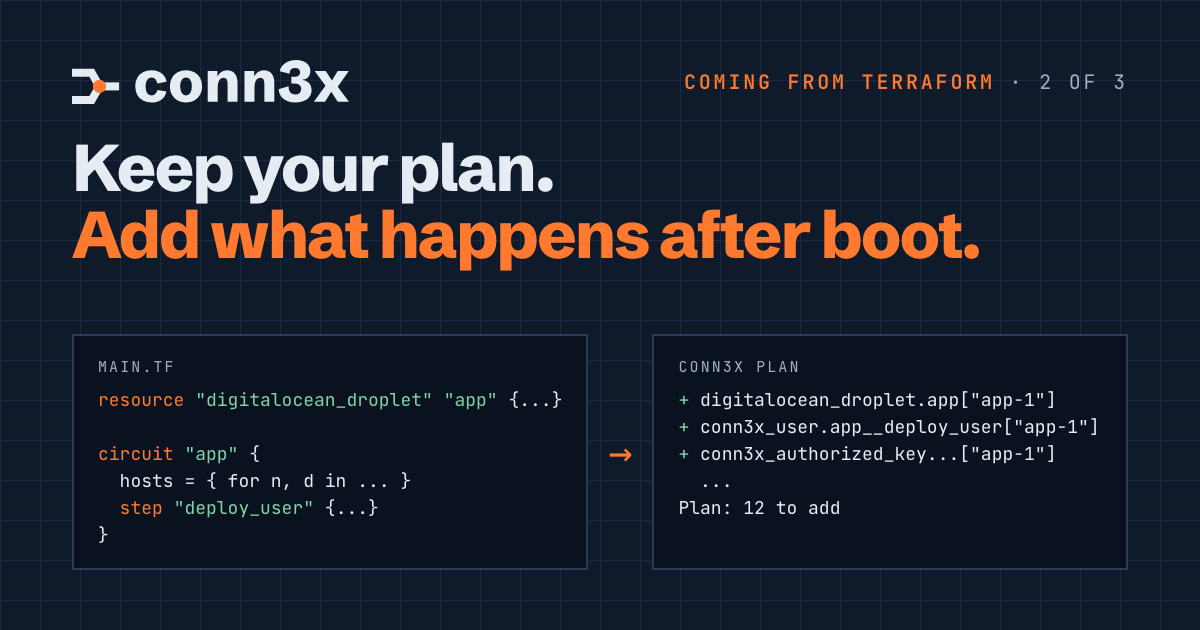
You already have the hard part. A plan you review before anything changes, state that remembers what’s out there, and a provider for everything you run. The gap is what happens after the machine boots, and today that gap gets filled with whatever’s nearest: a user_data script, a remote-exec provisioner, or a local-exec that hands the addresses to Ansible.
This is the second of three short posts for the readers from Why Conn3x is one tool. This one is for you if Terraform, or OpenTofu, came first.
What stays exactly the same
Conn3x is built on OpenTofu, so the configuration you have runs unchanged. The same .tf files, the same providers, the same modules. Run conn3x init and conn3x plan where you’d run terraform init and terraform plan.
Your state comes with you too. Conn3x reads and writes OpenTofu state, and OpenTofu reads Terraform state up to the versions it supports. The S3, GCS, azurerm, Kubernetes, Consul, PostgreSQL and HTTP backends are all built in. Back up your state before the first conn3x apply, the same as you would before any tool change.
What you add
One block, beside the resource that creates the servers. A circuit says what should be on each host, and its hosts come straight from your resources:
resource "digitalocean_droplet" "app" {
  for_each = local.servers
  name     = each.key
  image    = "rockylinux-10-x64"
  region   = "nyc3"
  size     = "s-1vcpu-1gb"
  # ...
}

circuit "app" {
  hosts = {
    for name, d in digitalocean_droplet.app : name => {
      address  = d.ipv4_address
      host_key = tls_private_key.host[name].public_key_openssh
    }
  }

  ssh {
    user = "root"
  }

  step "deploy_user" {
    user {
      name  = "deploy"
      shell = "/bin/bash"
    }
  }
}
That’s the shape of the DigitalOcean example, trimmed here to fit: the full one pins each server’s host key, so even the first connection is checked.
One plan for both layers
Here’s what conn3x plan says about that example, before a single droplet exists:
  # conn3x_authorized_key.app__deploy_key["app-1"] will be created
  # conn3x_user.app__deploy_user["app-1"] will be created
  # digitalocean_droplet.app["app-1"] will be created
  # tls_private_key.host["app-1"] will be created
  ...
Plan: 12 to add, 0 to change, 0 to destroy.
conn3x plan of the DigitalOcean example, with the resource lines picked out.The droplets and what goes on them, in one review. Once the servers exist, the host steps show a line-by-line diff of what’s on each one: the file that’s different, the package that’s missing.
Where it replaces what you use today
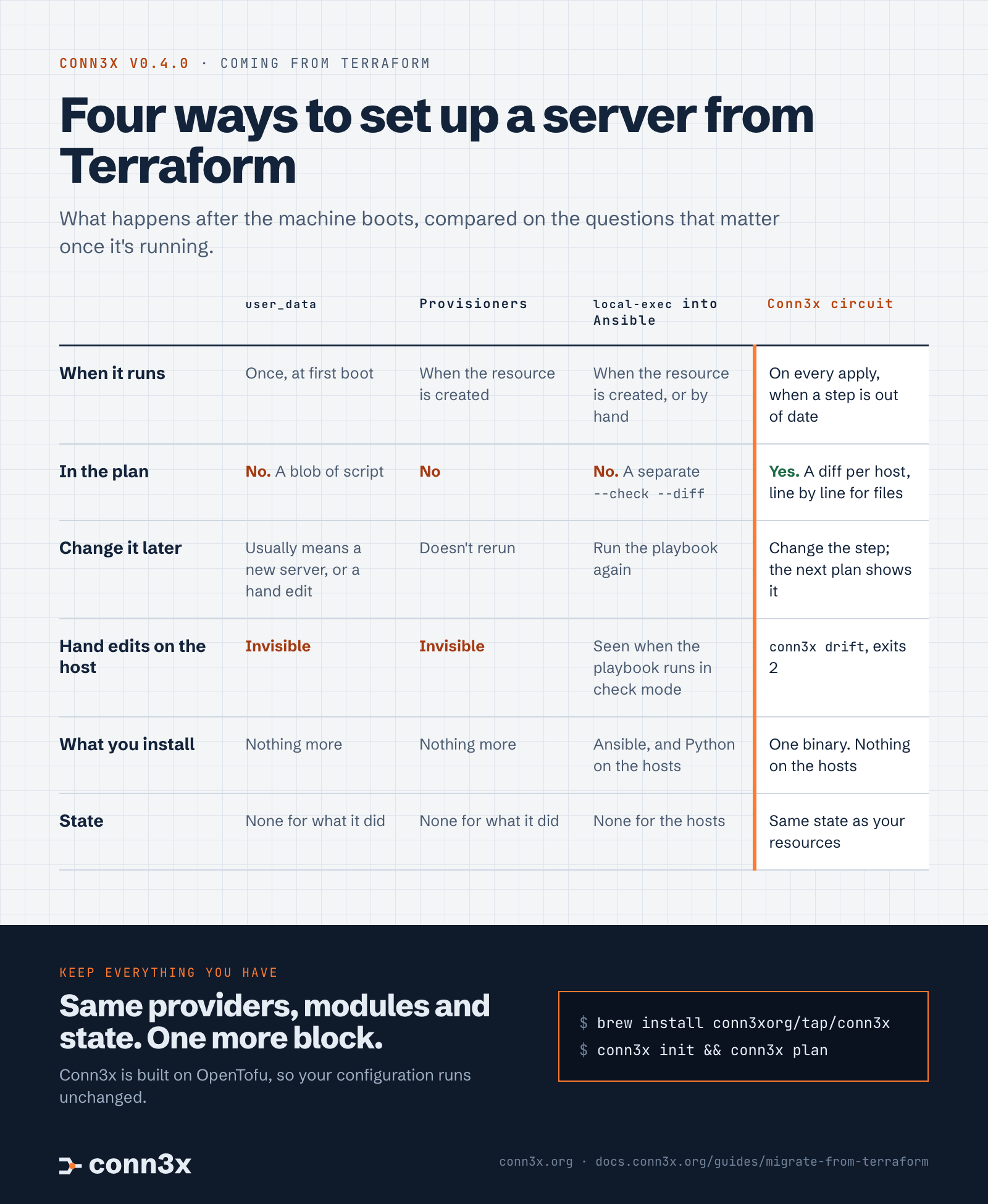
Read the comparison as text
- When it runs.
user_data: once, at first boot. Provisioners: when the resource is created.local-execinto Ansible: when the resource is created, or by hand. A Conn3x circuit: on every apply, when a step is out of date. - In the plan.
user_data: no, it’s a blob of script. Provisioners: no. Ansible: no, it’s a separate--check --diff. A circuit: yes, a diff per host, line by line for files. - Changing it later.
user_data: usually means a new server, or a hand edit. Provisioners: they don’t rerun. Ansible: run the playbook again. A circuit: change the step and the next plan shows it. - Hand edits on the host.
user_dataand provisioners: invisible. Ansible: seen when the playbook runs in check mode. A circuit:conn3x drift, which exits 2. - What you install.
user_dataand provisioners: nothing more. Ansible: Ansible, and Python on the hosts. A circuit: one binary, nothing on the hosts. - State.
user_dataand provisioners: none for what they did. Ansible: none for the hosts. A circuit: the same state as your resources.
user_data runs once, at first boot, and then it’s done. Terraform never sees what it did, so if someone changes the server later, nothing tells you.
Provisioners run when the resource is created, not when you change what they’d do, and HashiCorp’s own docs call them a last resort.
local-exec into Ansible works, and plenty of teams run it. It also means a second tool, an inventory to keep in step, and a second run nobody can preview in the same plan.
A circuit is checked on every plan. Conn3x reads the host, compares it with the configuration, and shows the difference before it changes anything. conn3x drift checks the cloud and the hosts together and exits 2 when something changed by hand.
Try it beside what you have
Copy a working directory, back up its state, and add a circuit for one server you don’t mind touching:
brew install conn3xorg/tap/conn3x
conn3x init
conn3x plan
Use Conn3x with your Terraform configuration covers state and backends, and Create and configure a server in one plan walks through a complete example. If a provider or backend you rely on doesn’t behave, tell us.